a quick rundown
The tl;dr
Problem:
There are more tigers in US captivity than in the wild on the entire planet. The ones in cages spend nearly a quarter of their day pacing. Current enrichment is generic, unmeasured, and built on the wrong premise.
What I did:
A scope analysis on tiger biology and enrichment techniques. Built a new observation framework, a system of products, an enclosure, and an app.
What we found:
Enrichment is failing because the field measures engagement as a yes or no. There are current technologies that can be used in different ways to improve their life.
What we built:
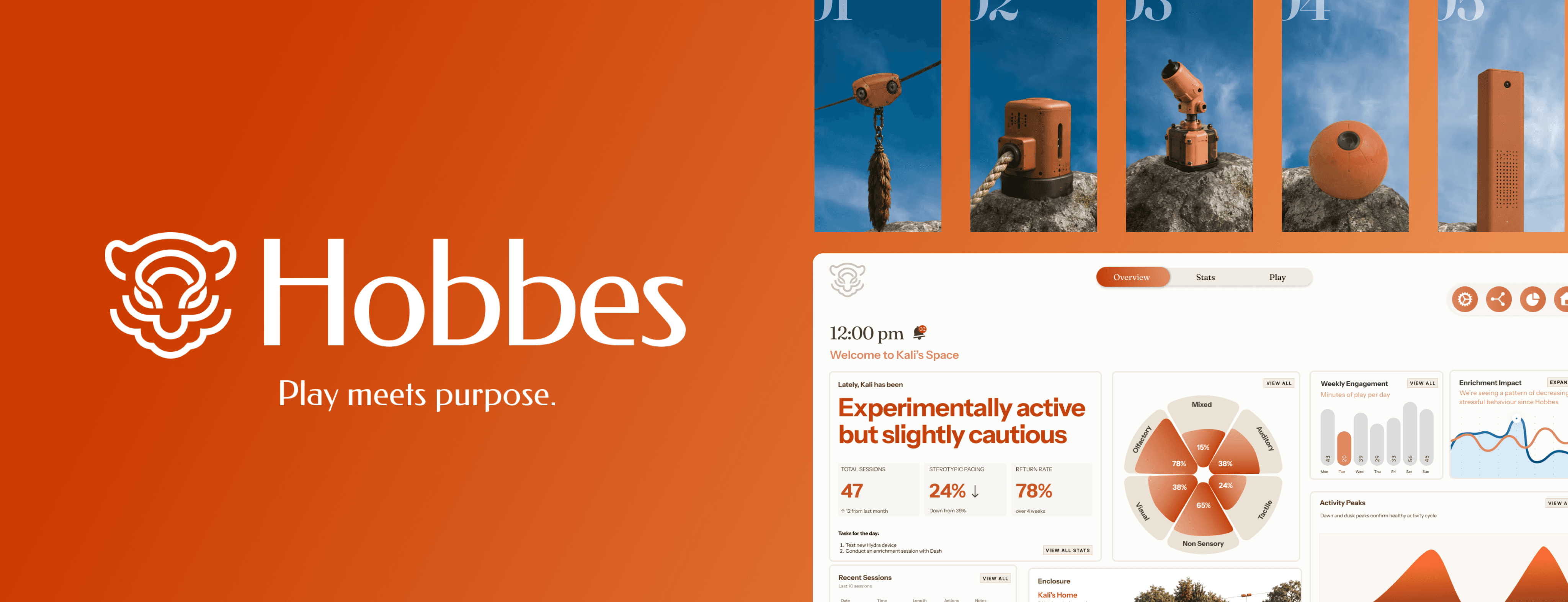
Hobbes. A sensor-equipped enclosure, a system of remotely-activated enrichment products tuned to individual tigers, an app for caretakers to monitor welfare, run protocols, and play with their tigers while staying out of their space.
Role
Researcher
Product Designer
Team
Independent
Timeline
4 months
Tools
Figma · MidJourney
Some more context
There are more tigers in cages than in the wild.
Once, a hundred thousand tigers roamed across Asia. Today, around 5,500 are left in the wild. A 95% collapse, occupying less than 7% of their historical range. Three of nine subspecies are already extinct.
Meanwhile, 5,000+ tigers live in captivity in the United States alone. More than exist in the entire wild, on the entire planet, combined.
5,500
tigers left in the wild, globally
83%
tigers in US captivity alone
(Jhala et al., 2025; Mohapatra et al., 2014)
The species most defined by wildness is now increasingly defined by captivity. And the tools we use to make captivity bearable haven't kept up with the science of what these animals actually need.
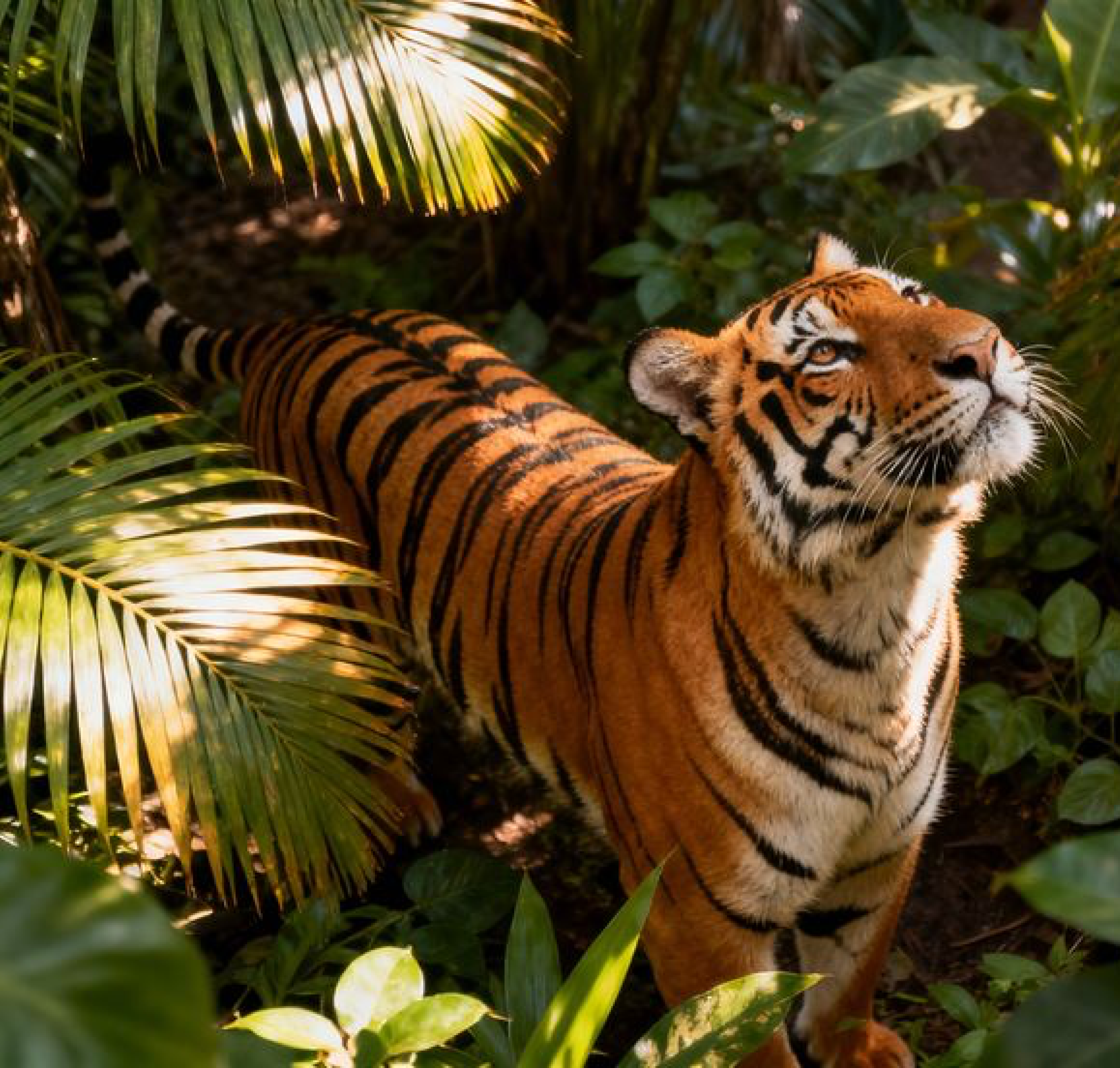
So, if so many tigers are in our care, how can we do better by them?
what life looks like in captivity
Failing environments and the cost of captivity
A captive tiger isn't always a captured one. Some are rescues. Some are recovering from injury. Some were orphaned too young to survive on their own. Some live in sanctuaries because release would kill them.
The reasons vary. The reality doesn't. Captivity, no matter how well-intentioned, costs the animal something.
Captive tigers routinely develop stereotypic behaviors such as repetitive, purposeless actions that do not occur in wild populations.
23%
captive tiger's spend day pacing
Other Stereotypic Behaviors
head-bobbing
compulsive licking
bar biting
self-mutilation
The term "zoochosis," coined in 1992, describes this captivity-induced psychological distress. Critically, these behaviors are not "quirks." Research has shown that behavior is an animal's first attempt to cope with a stressor (Vaz et al., 2017). Keeping all of this in mind, it begs the question:
Aren't there ways to prevent stereotypic behaviors?
What is enrichment and why is it important
Is Enrichment the answer to all our problems?
Enrichment is a key part of any animals life regardless of where they are and how it manifests. Int the wild, tigers take matter into their own hands and get stimulation from their natural environment. However, in captivity this gets a bit tricky. Enrichment is received via humans in a much more controlled and limited setting.
Currently, tigers' enrichment comes in the form of: novel scents, food puzzles, rotated objects, varied feeding routines, environmental complexity.
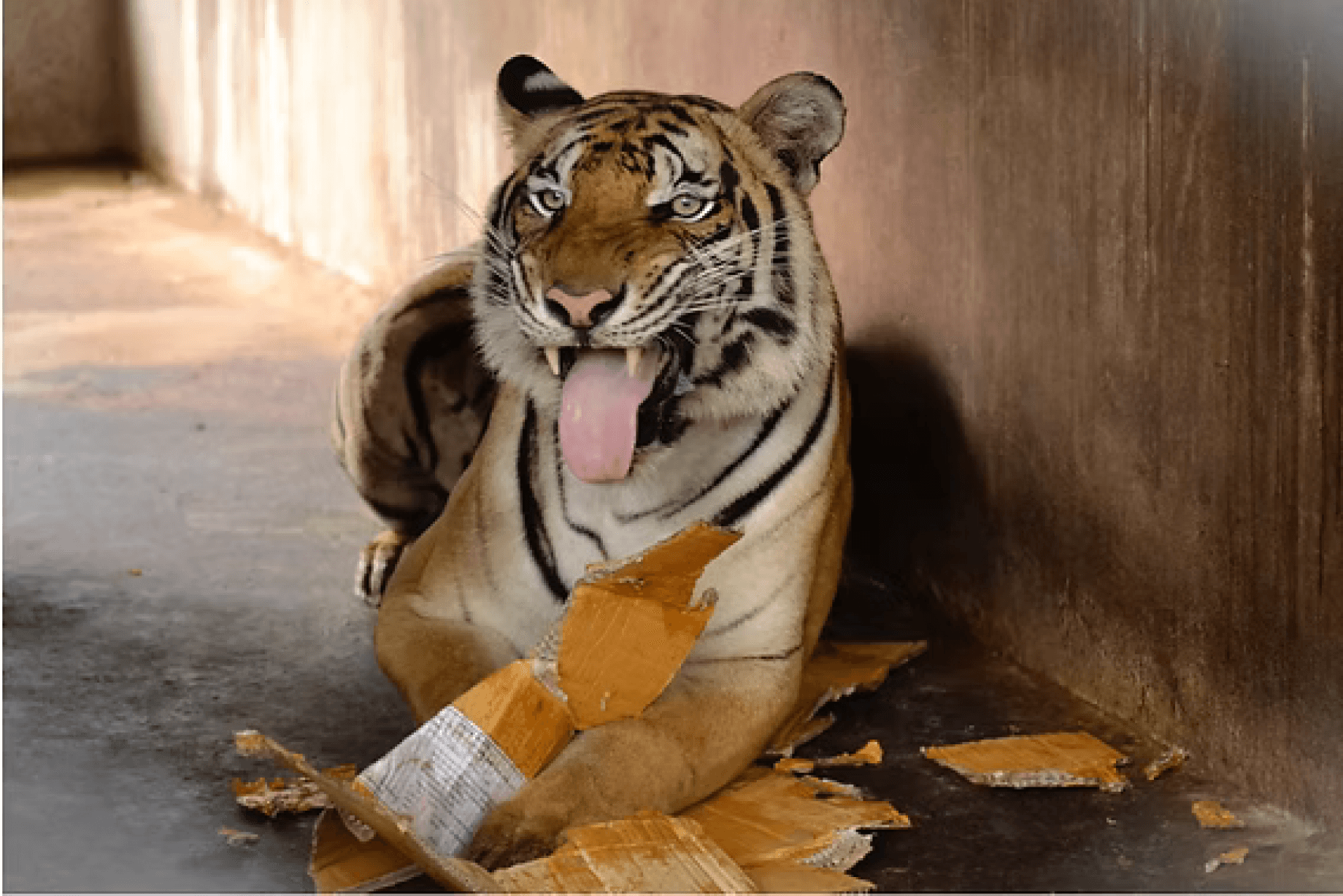
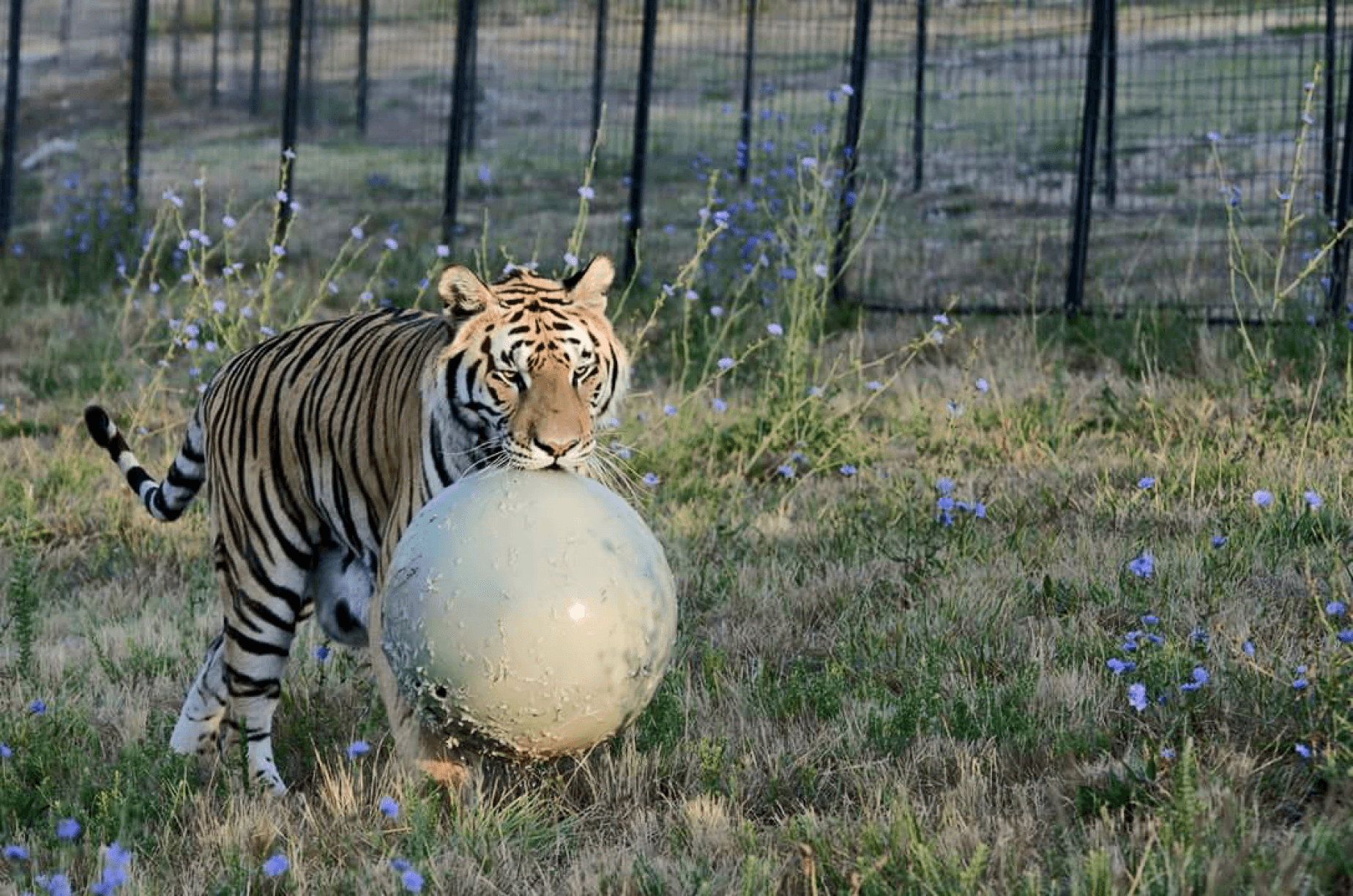
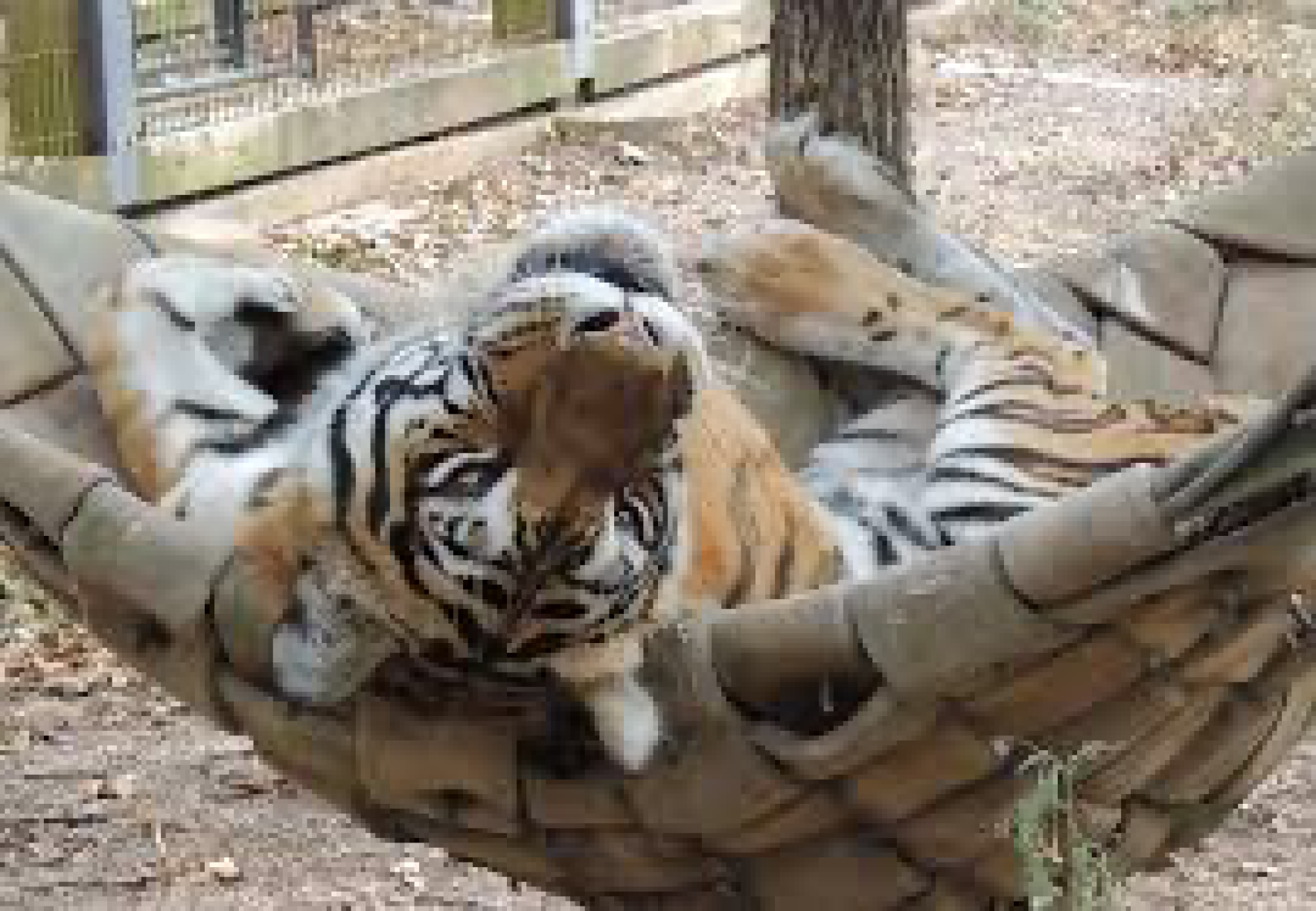
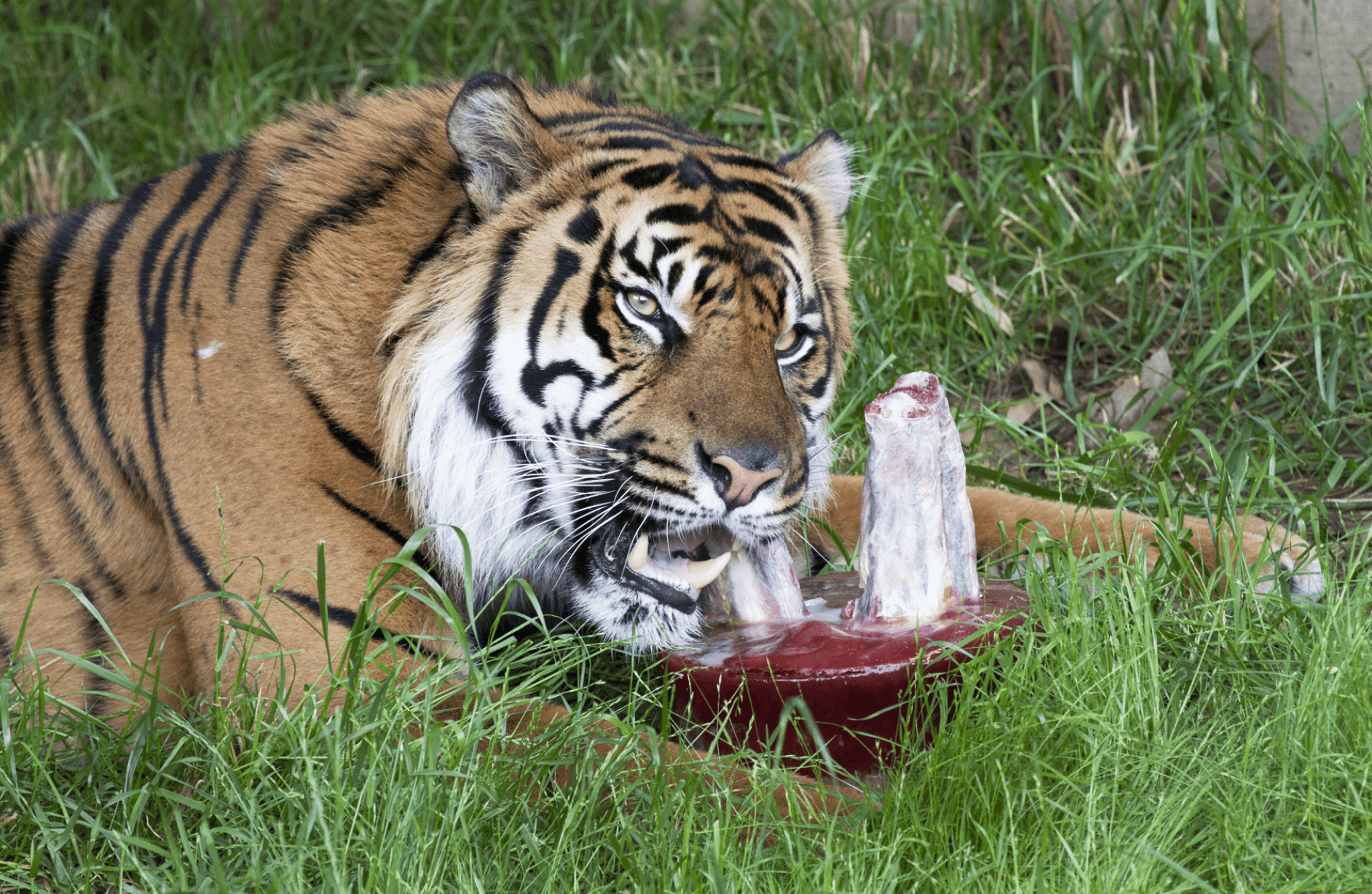
The literature is clear that it helps. Olfactory stimulation produces some of the most reliable engagement responses in any species. Variable schedules reduce stereotypic pacing more effectively than just adding more stuff.
Tigers in well-enriched enclosures show measurable improvements in welfare markers. Regardless of all the information on why it works and how it's good for them, we some how com back to:
If we're already practicing enrichment with tigers, why are they still struggling?
Sneak Peak
My Solution
Enrichment is a key part of any animals life regalress of where they are. For tigers enrichment comes in the form of: novel scents, food puzzles, rotated objects, varied feeding routines, environmental complexity.
Introducing
Hobbes
Play meets purpose.


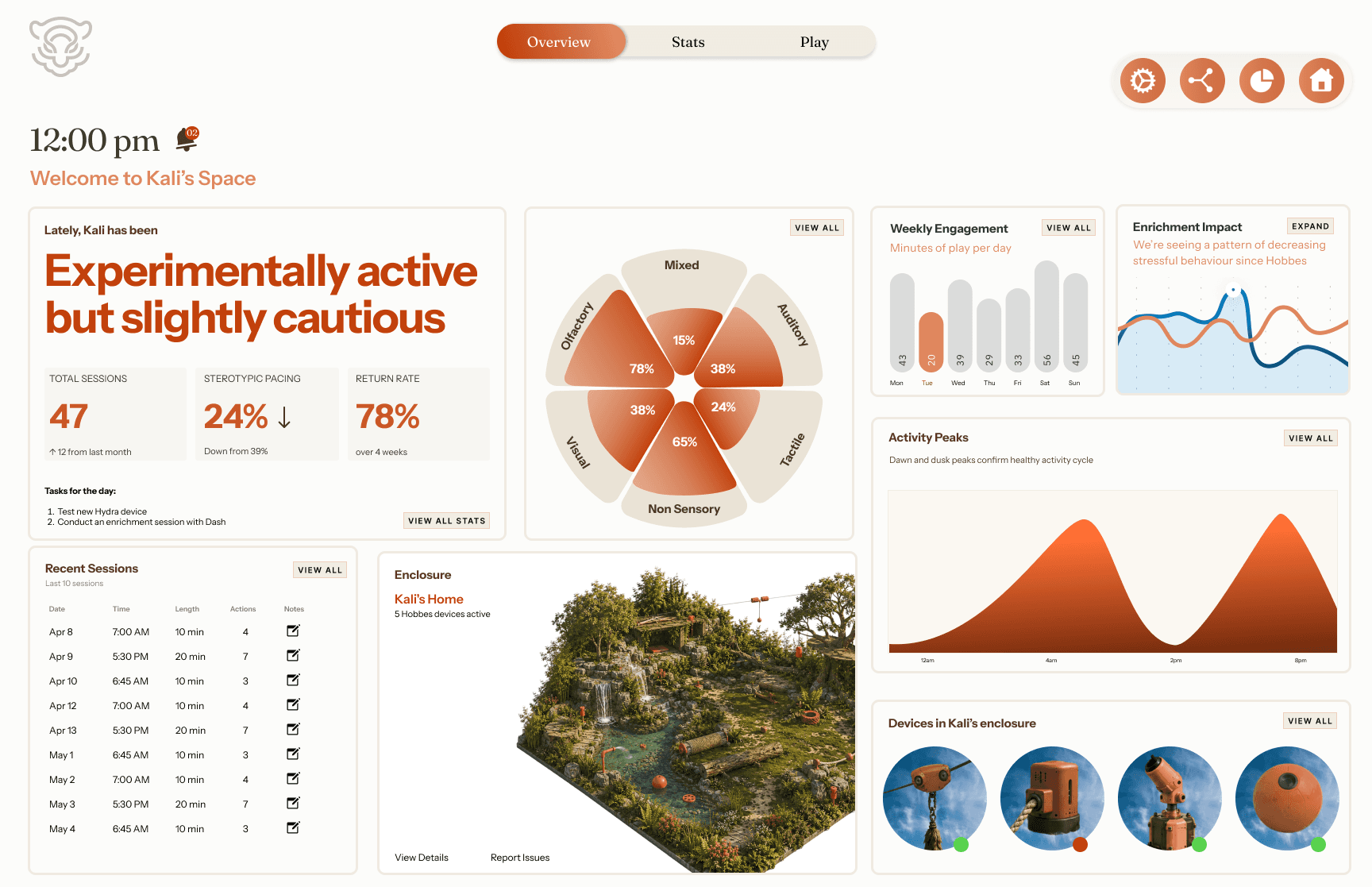
One platform. Five products.
Every session learns what they love, what they ignore, and what keeps them coming back.
Their play shapes the system.
The system shapes their day.
So, how did we get here?
Back to the beginning
The Research Process
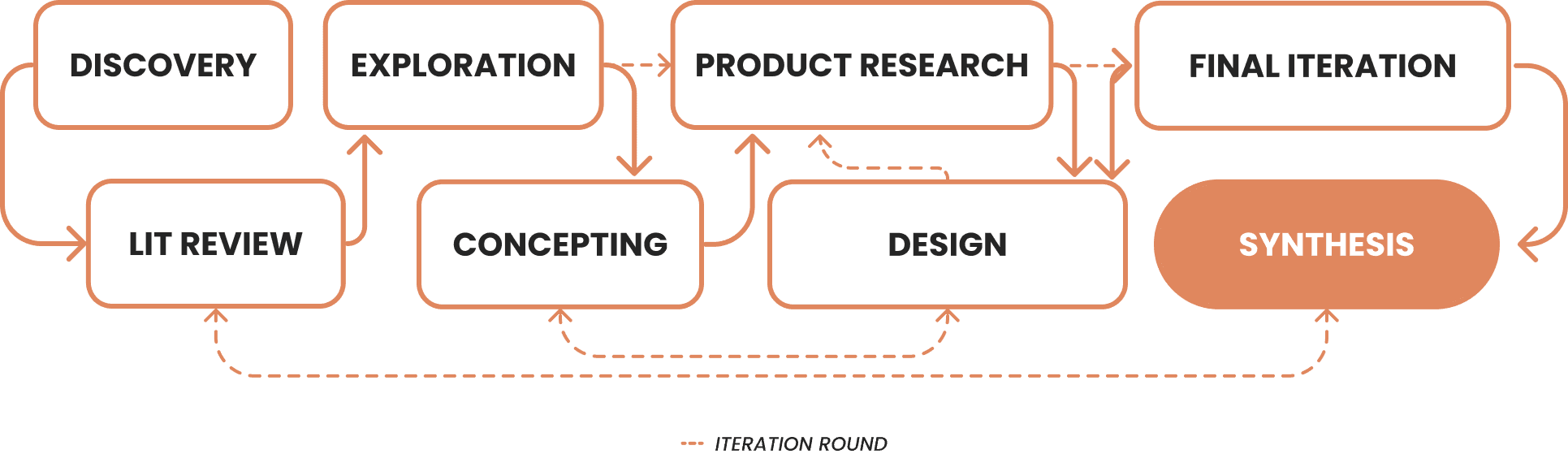
The process of research, much like every other project was primarily working on discover, literature, more xploration concepting and so on adn so forth.
I started my research with a lotus chat. the chart helped explore question i wanted to ask as well as try to answer.
From there i narrowed down on a couple of questions which inlcluded, what do cubs needs, what does captivity do to them and mostly, what do they need?
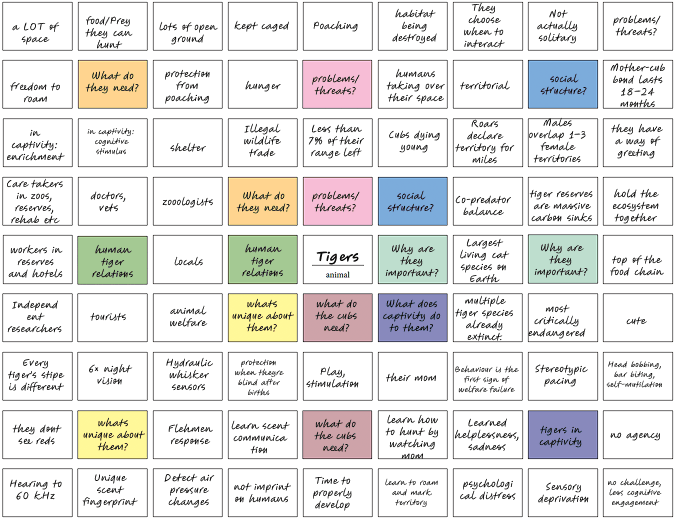
Tigers don't see red. They hear three times what we hear. Their whiskers are hydraulic sensors that read air pressure in total darkness. Their social life runs entirely on scent. Every tiger has a unique scent fingerprint. They are not the animal most people picture.
And captivity breaks them. 23% of a captive tiger's day spent pacing. Zero hunting. Predictable feeding that removes every cognitive challenge. Concrete where there should be forest.
The enrichment meant to fix this? A plastic ball. A frozen popsicle. A sack sprayed with perfume.
And the way we measure whether any of it works? Binary. Did the tiger touch it or not.
Nobody is asking how the tiger engaged. Nobody is tracking which senses were activated. Nobody is building a profile of what this specific tiger actually responds to.
that gap is where the project started.
Before designing anything, I needed a tool to capture what the existing methods couldn't. So I built one.
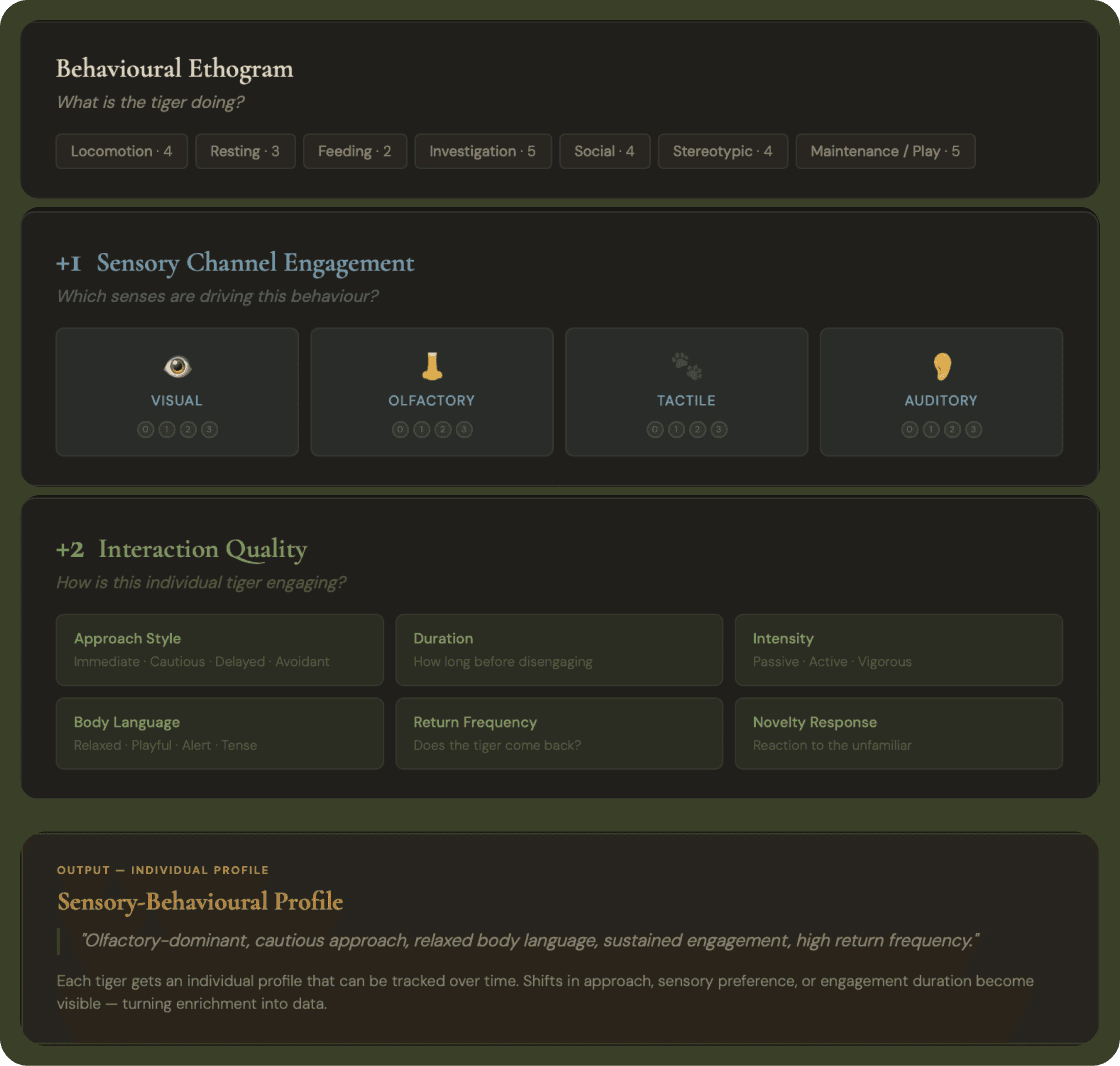
The Hobbes Method is a structured observation tool built on top of a standard behavioral ethogram.
Where the ethogram records what a tiger is doing, the Hobbes Method adds two layers:
which senses are driving the behaviour, and
how the tiger is engaging.
Together, they turn a basic observation into an individual profile — one that can be tracked over time and used to understand what each tiger needs.
I explored multiple avenues of what exists in the world of tigers that directy as well as indirectly impacts them. This exploration extended beyond just design. It spanned:
Analogous Technology & Animal-Computer Interaction
Legislation & Policy
Broader Design & Infrastructure Affecting Tigers
Existing Tiger-Related Technology & Design
Cub-Specific Design Constraints
Climate Factors
The gaps were clear. No enrichment device generates behavioural data. No system profiles individuals. No framework connects how a tiger plays to whether it's developing the behaviours it would need in the wild.
Enrichment and assessment live in separate worlds. That became the design space.
At this point in the project I knew I definitely wanted to work on enrichment but i was confused about what stage of a tigers life cycle I'm designing for. I sketched out 20 design concepts to explore the pissibilties of what could work for tigers or in some speculative states what human products could learn from tigers.
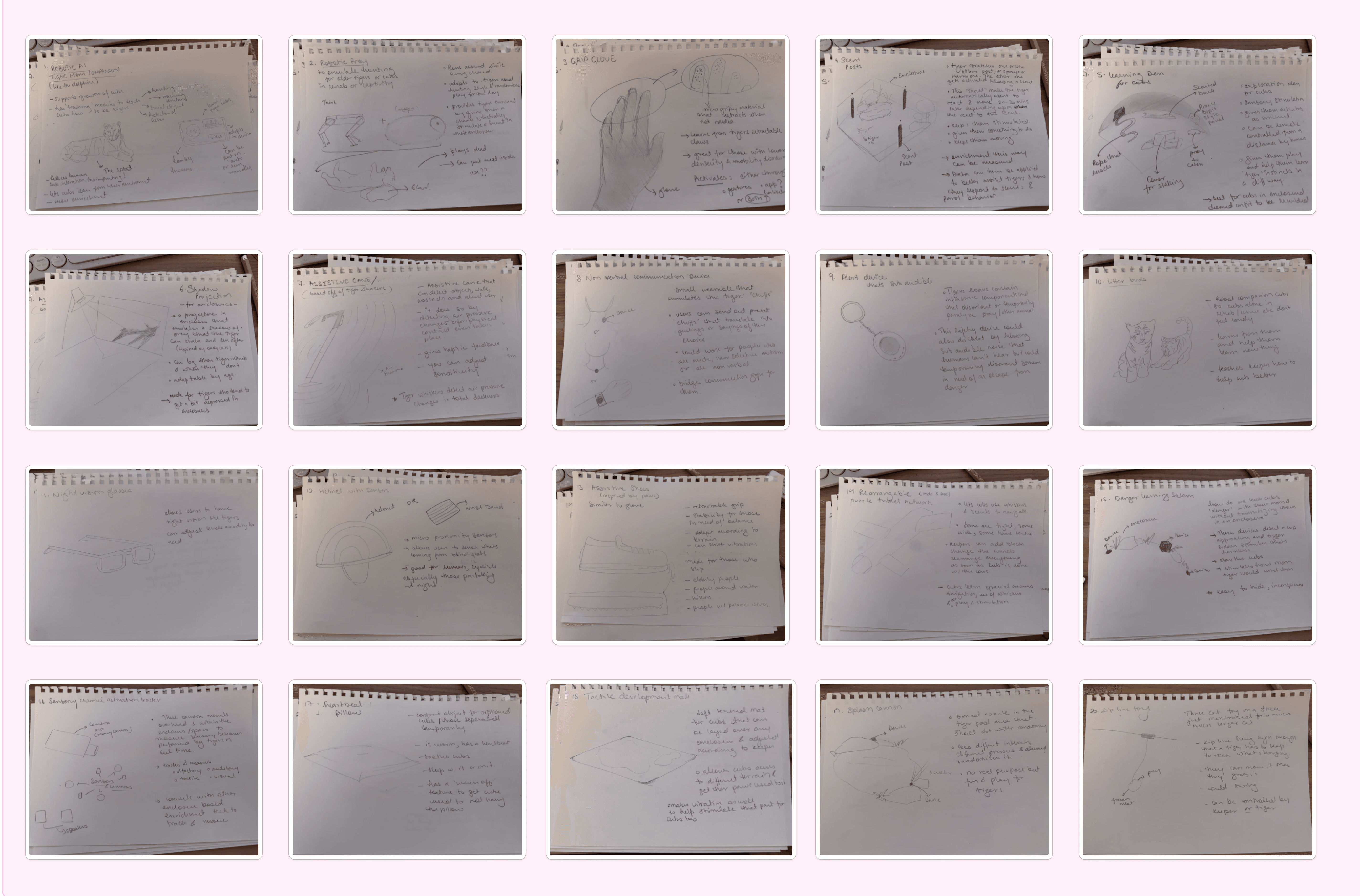
This process helped with exploring niche issues that need solving for tigers. todwards the end, i decided to merge 6 of the sketches that had a similar premise and turn it into one concept.
creating hobbes
Designing the Product
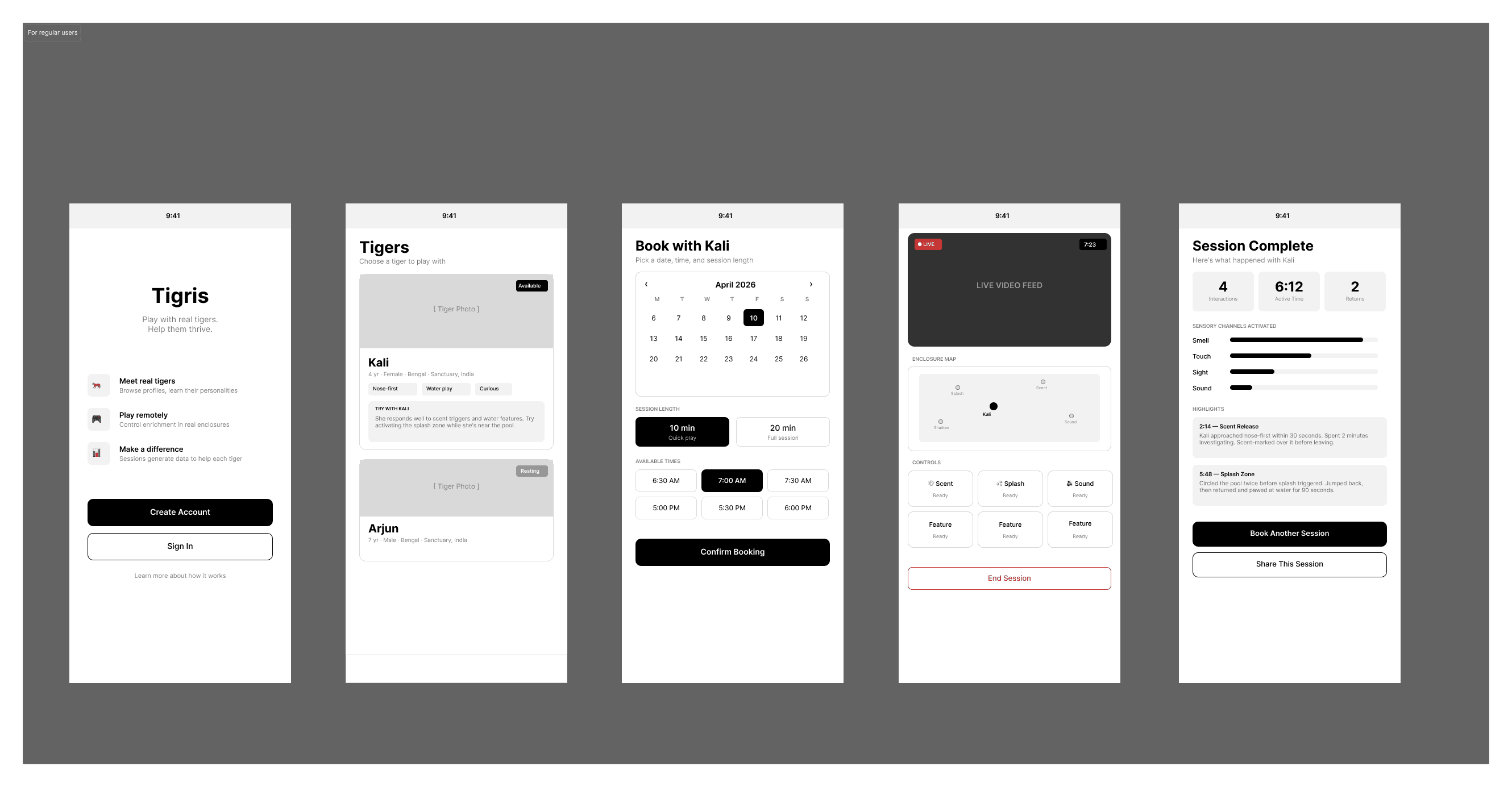
Getting started on ideating how this experience would look now that we combines 6 concepts from the sketches i began wireframing a few flows that could work for the devices.
V1: For the Regular Consumer.
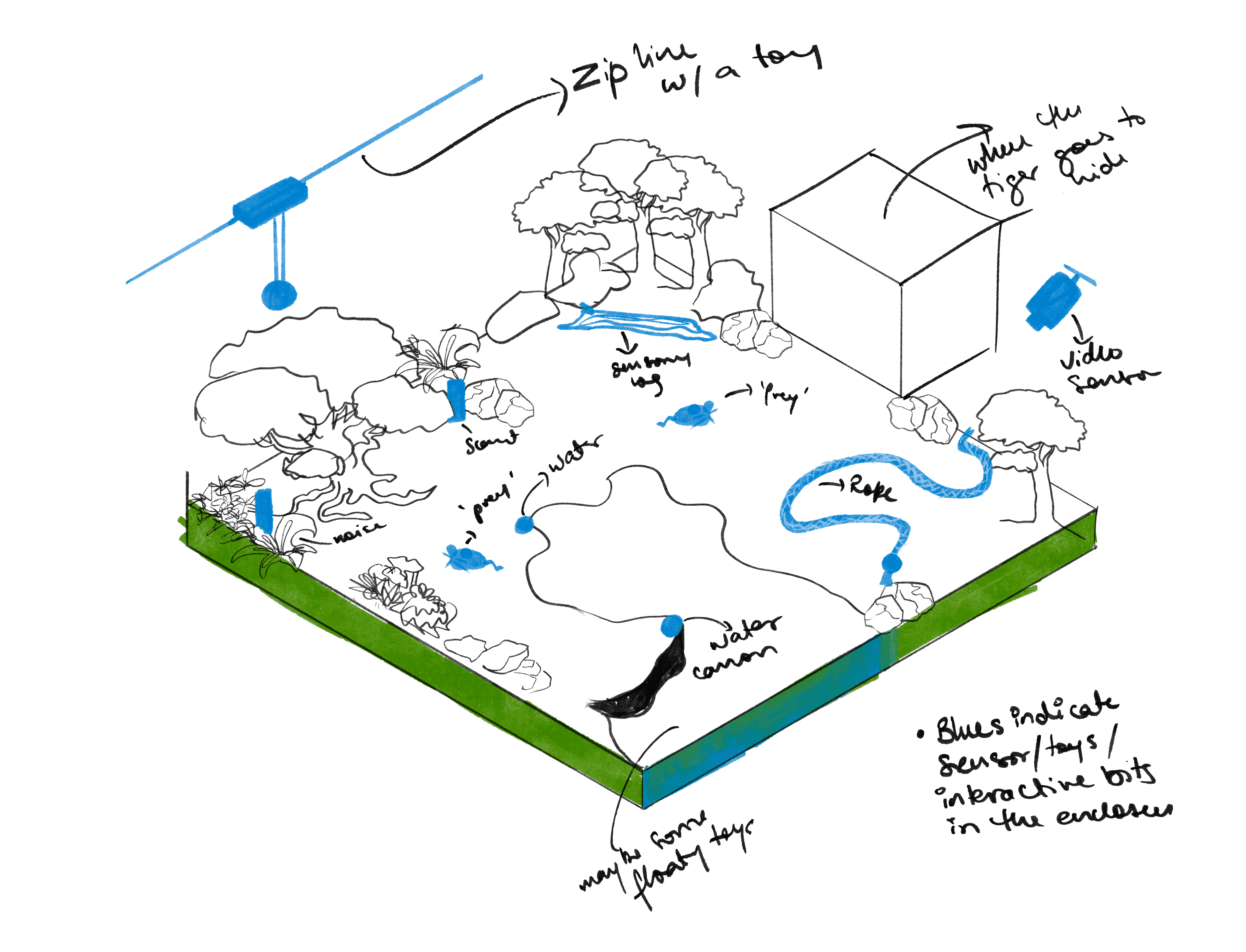
Environment sektch
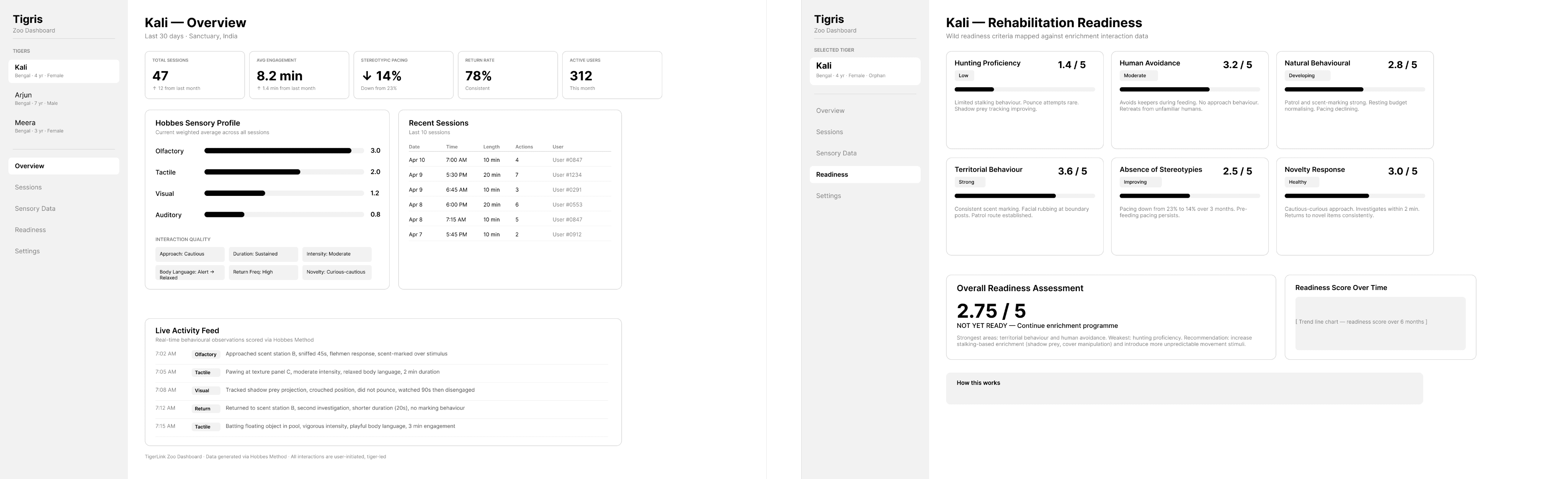
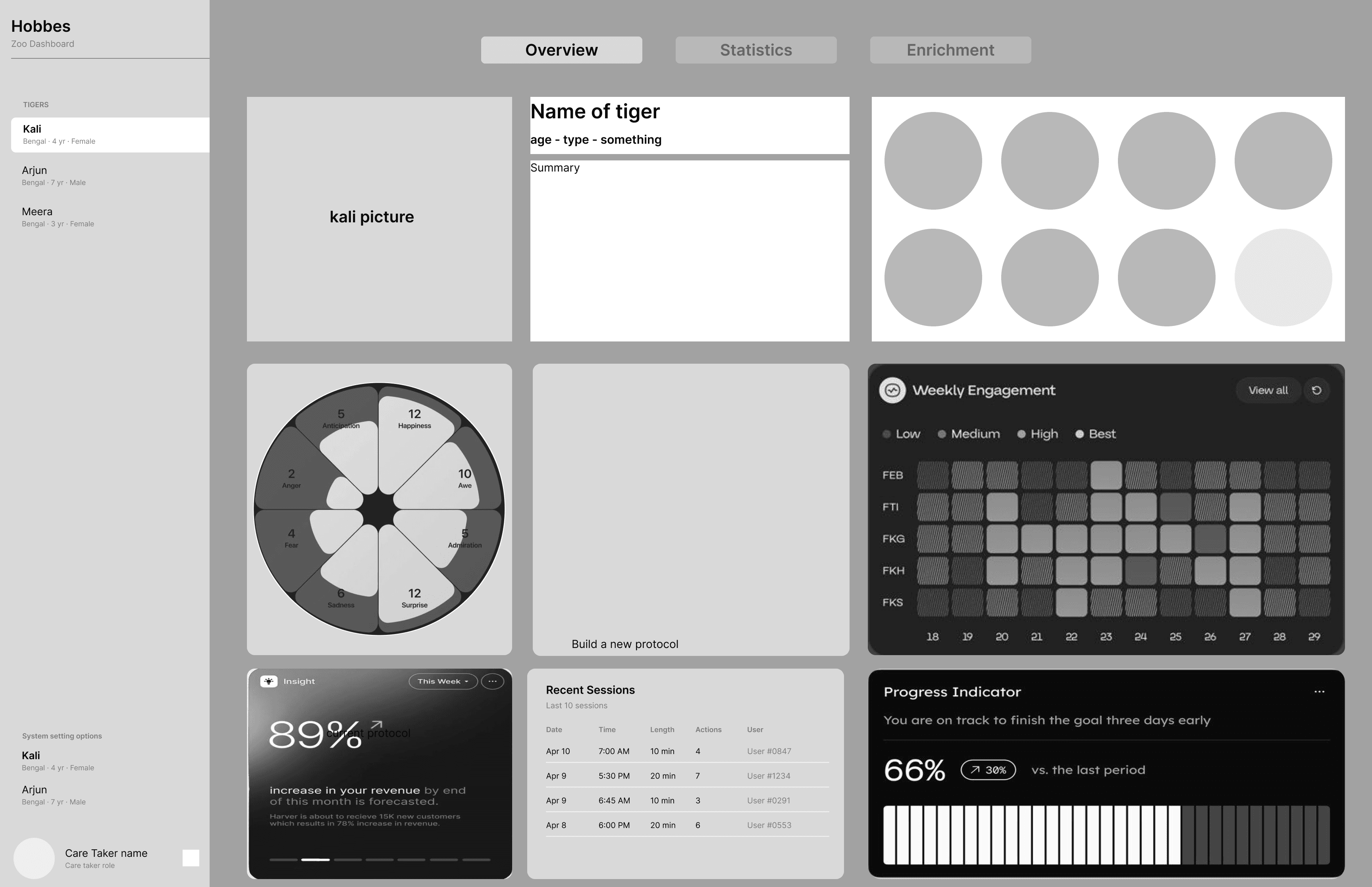
V2: For The Care Takers
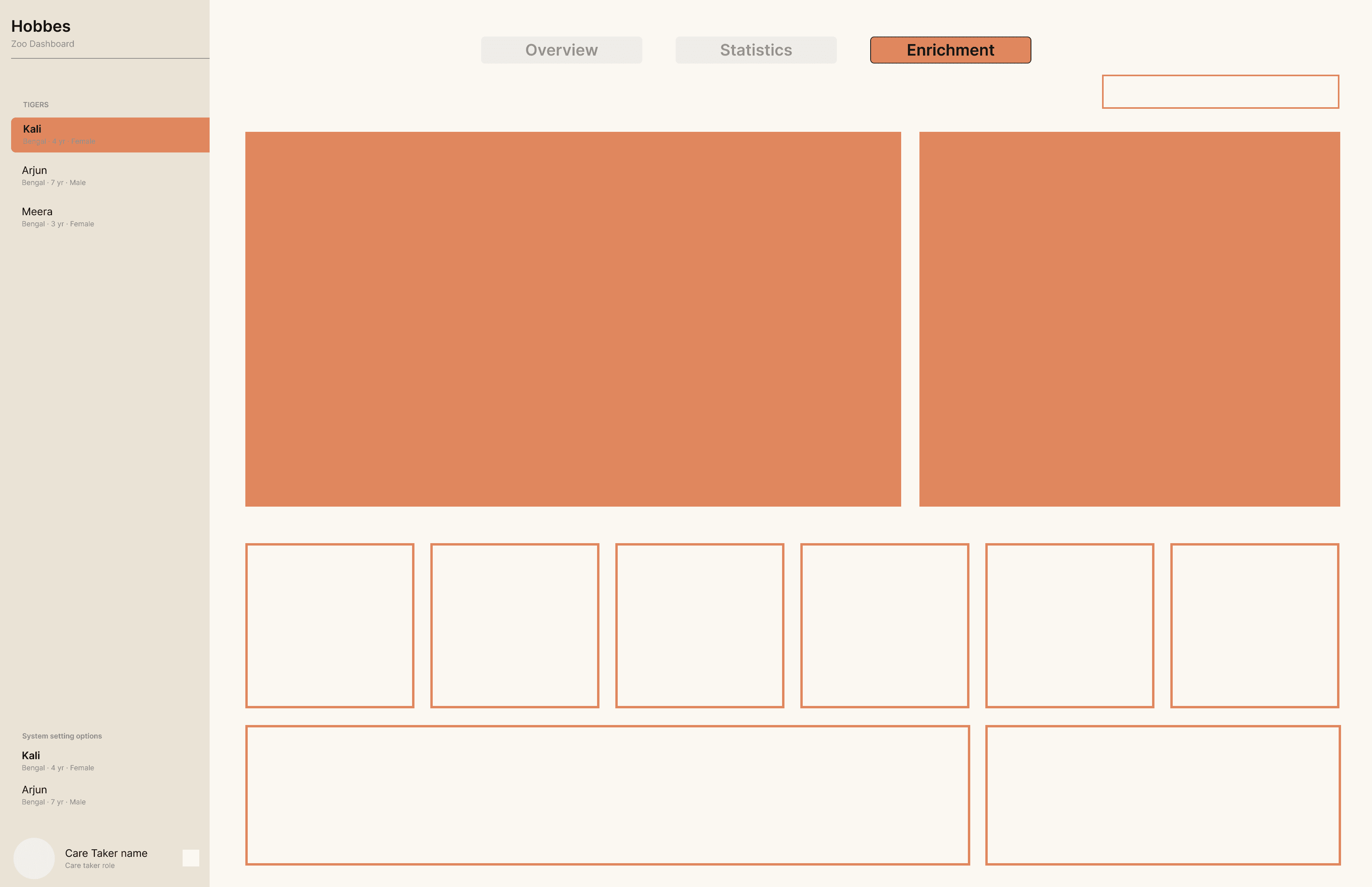
Creating heuristics to evaluate my design
How do you prioritize the tiger when designing?
Designing for animals is different from designing for people. They can't tell you what they want, what frustrates them, or what's working. (Unless it's a parrot, but that's a different project.) You have to read behaviour, not feedback.
Before finalising any of my designs, I created a set of seven heuristics to evaluate every concept against. If a design didn't meet them, it was either reworked or removed entirely.
Can the animal understand how to interact with it without being taught?
Does it have a positive impact on the animal in the long and short term? If there's a short-term tradeoff, is it worth the long-term gain?
Does it cause fear, stress, or overwhelm? Could it cause physical or mental harm?
Is the animal visibly excited to engage, or are they avoiding it?
Are there safeguards to protect the animal from exploitation or mistreatment?
Does it improve enrichment in a way that is meaningfully better than what already exists?
Does it encourage and support natural instincts rather than working against them?
Introducing Hobbes (again but in detail)
The Final Design

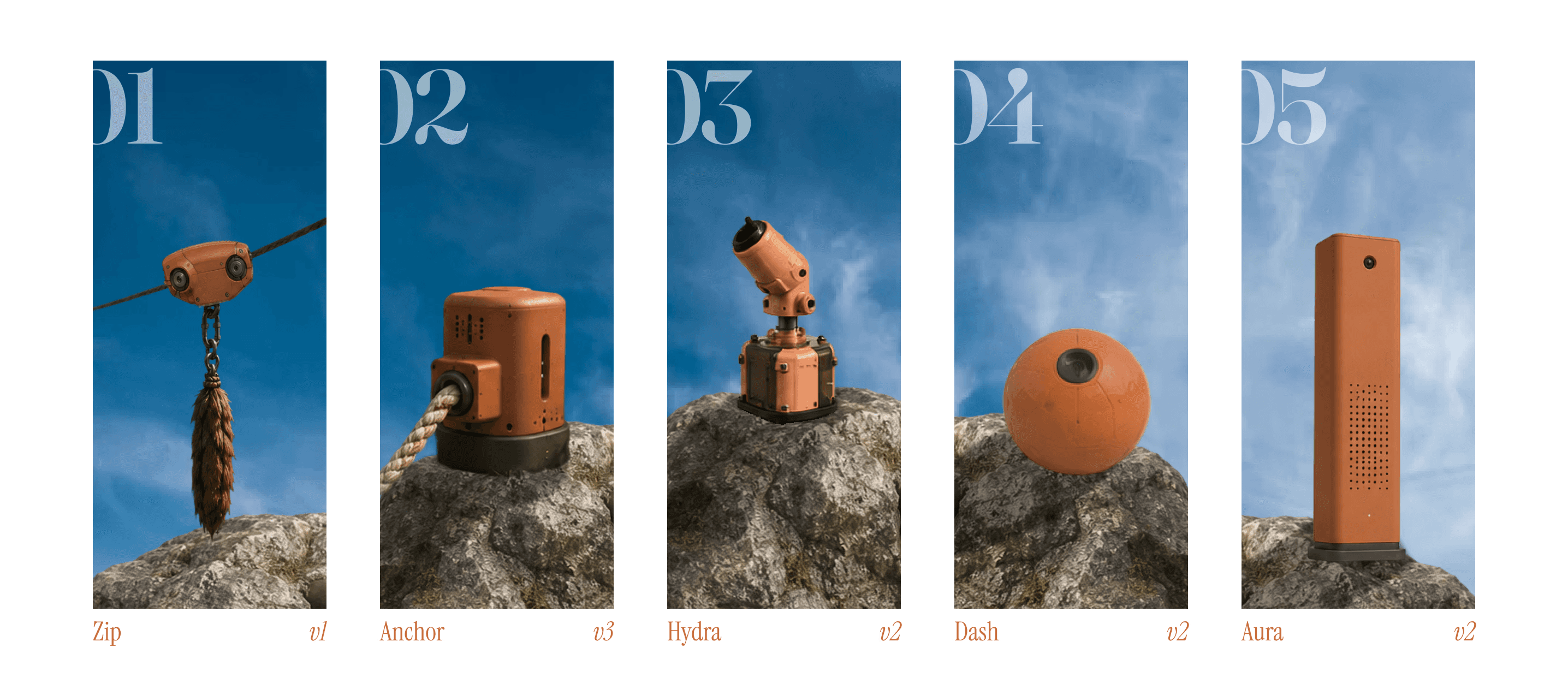
The line of producst includes 5 main proucts aside from hte suusal cameras andsensors that come with the hobbes kit that make the hwhole system work. these products are customisable, adaptble and smart. the adapt to the tiger and learn from them interactions. some even have ways to interact with them. Lets look slightly deeper into each
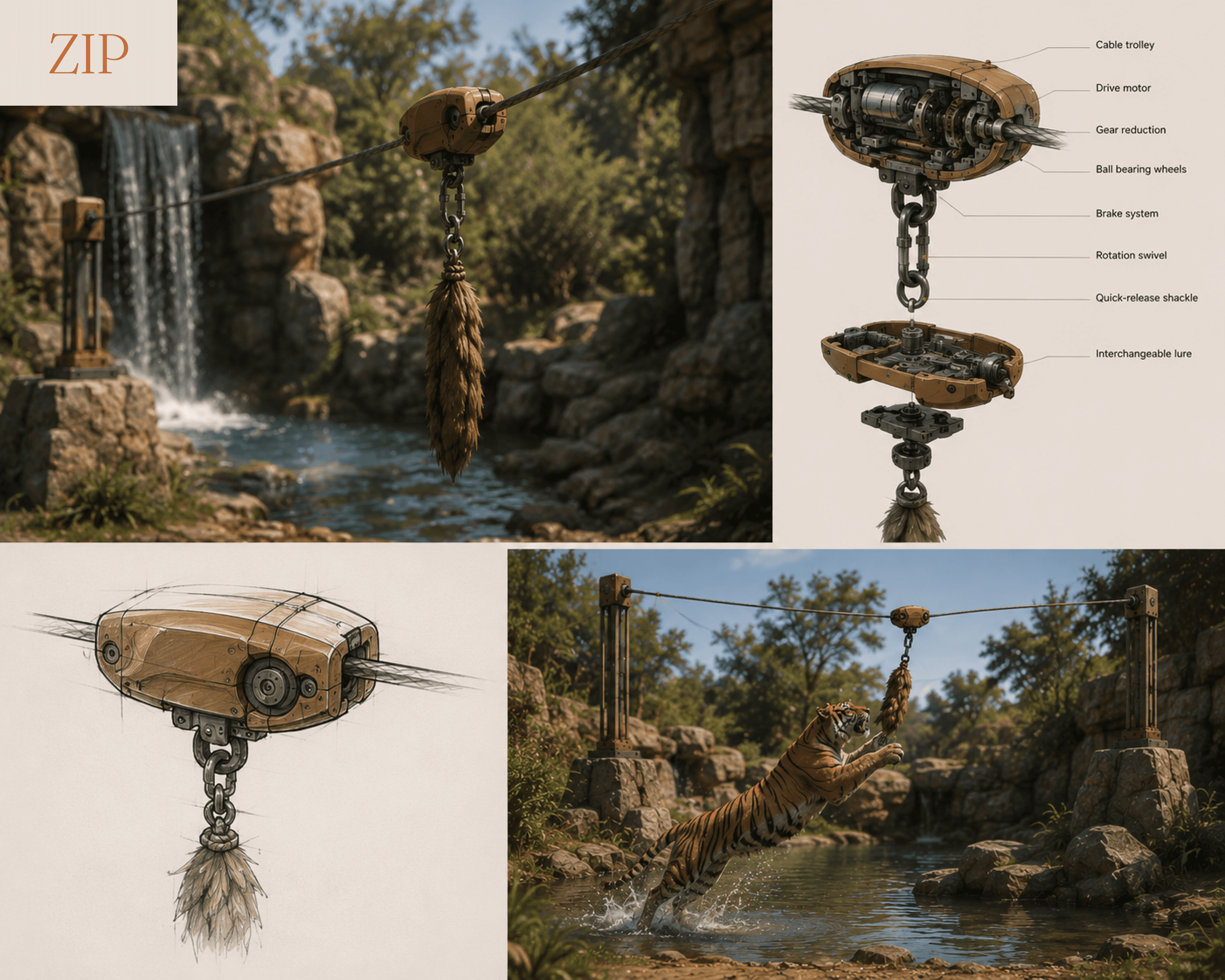
Zip
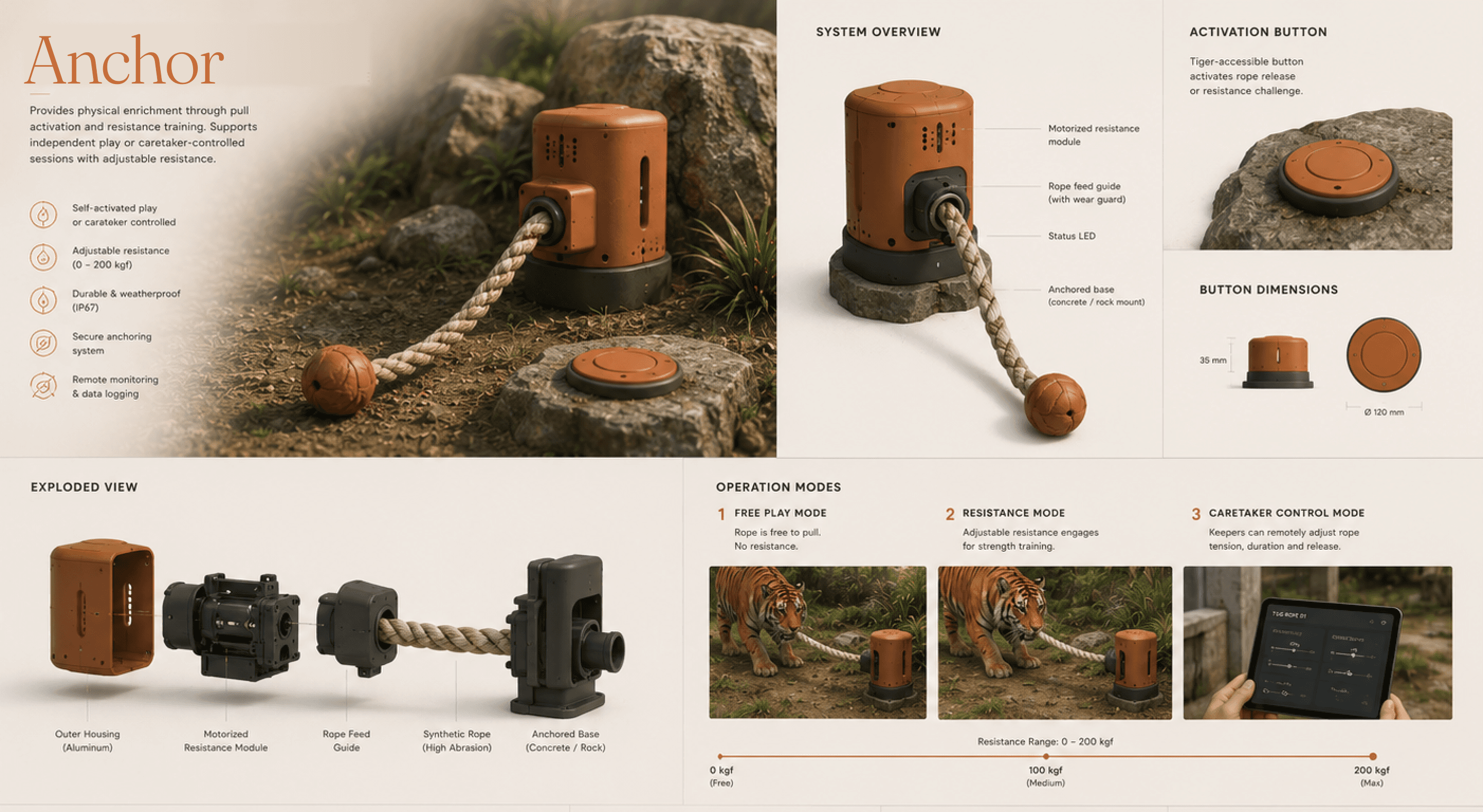
Anchor
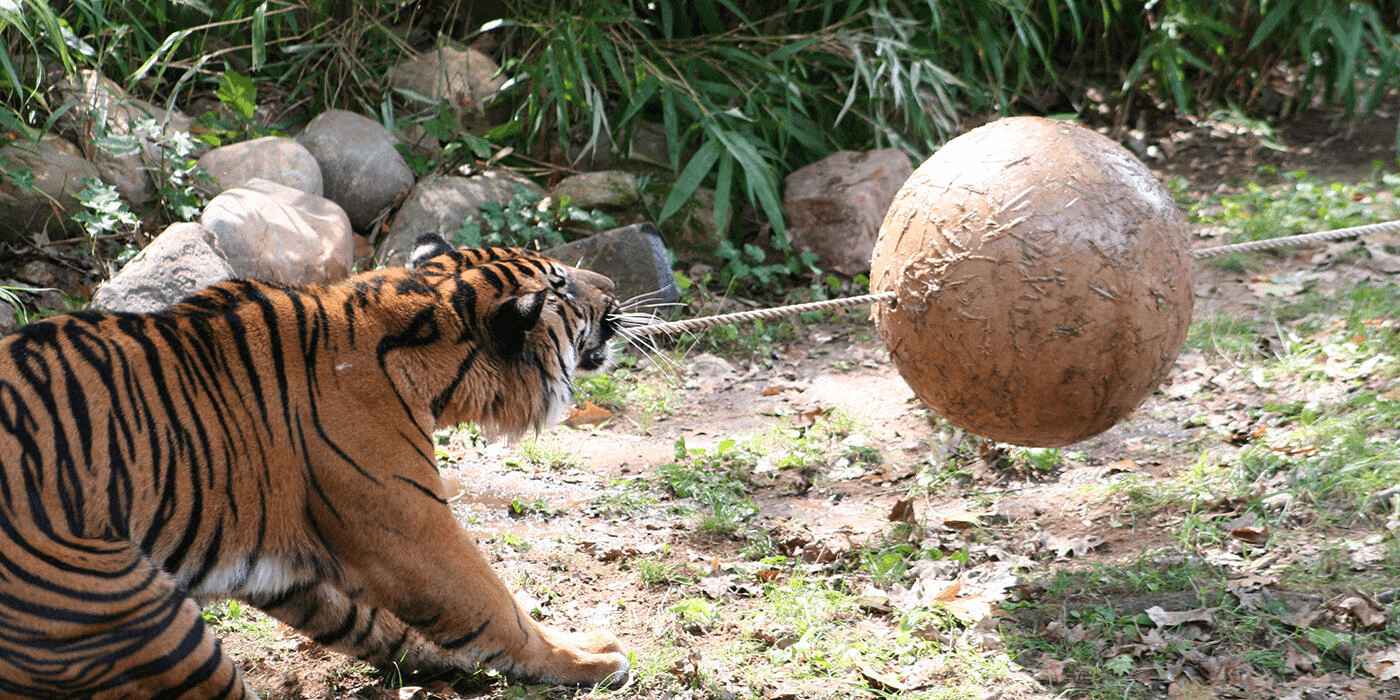
Anchor is a wall-mounted resistance rope. One end is anchored, the other moves on its own or resists when the tiger pulls. Resistance level is adjustable.
targets pulling, dragging, and physical engagement, mimicking the experience of dragging prey.
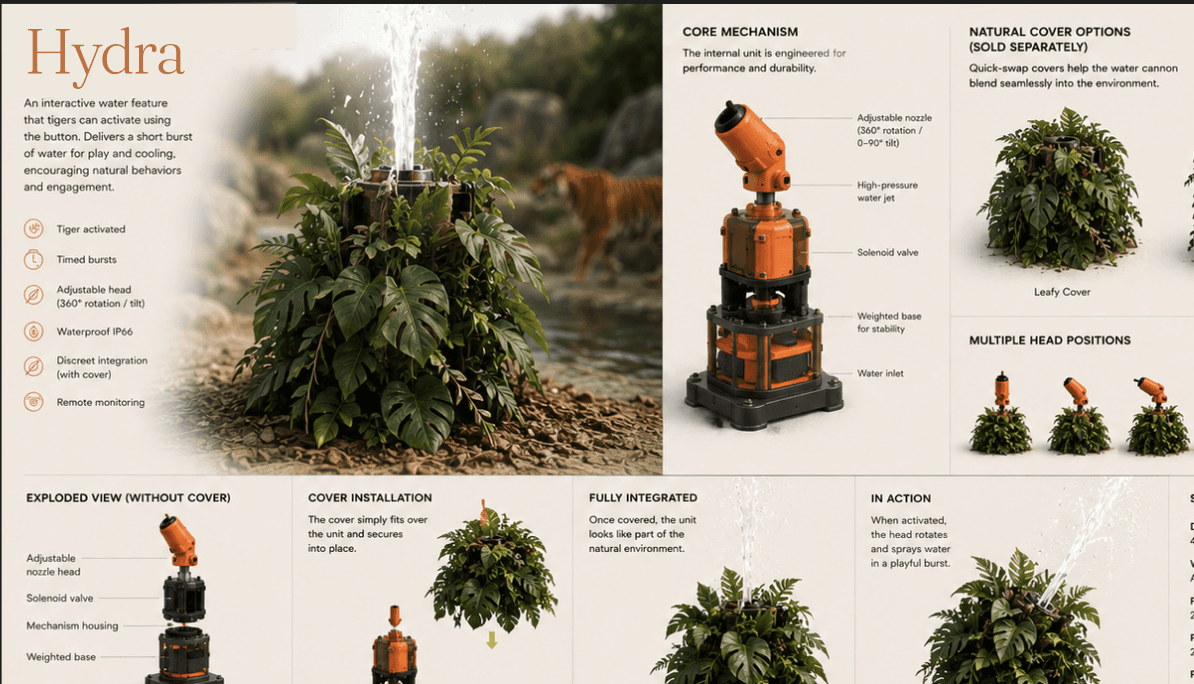
Hydra
Hydra is a water cannon disguised as a rock or plant formation. It delivers unpredictable water bursts at variable pressure and direction. Tigers are water-positive animals and Hydra turns that into active play.
It can be triggered remotely by a caretaker or set to activate on a randomized schedule.
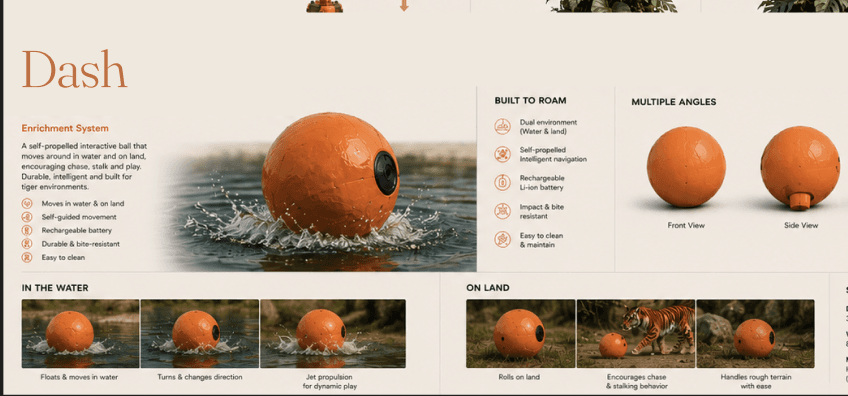
Dash
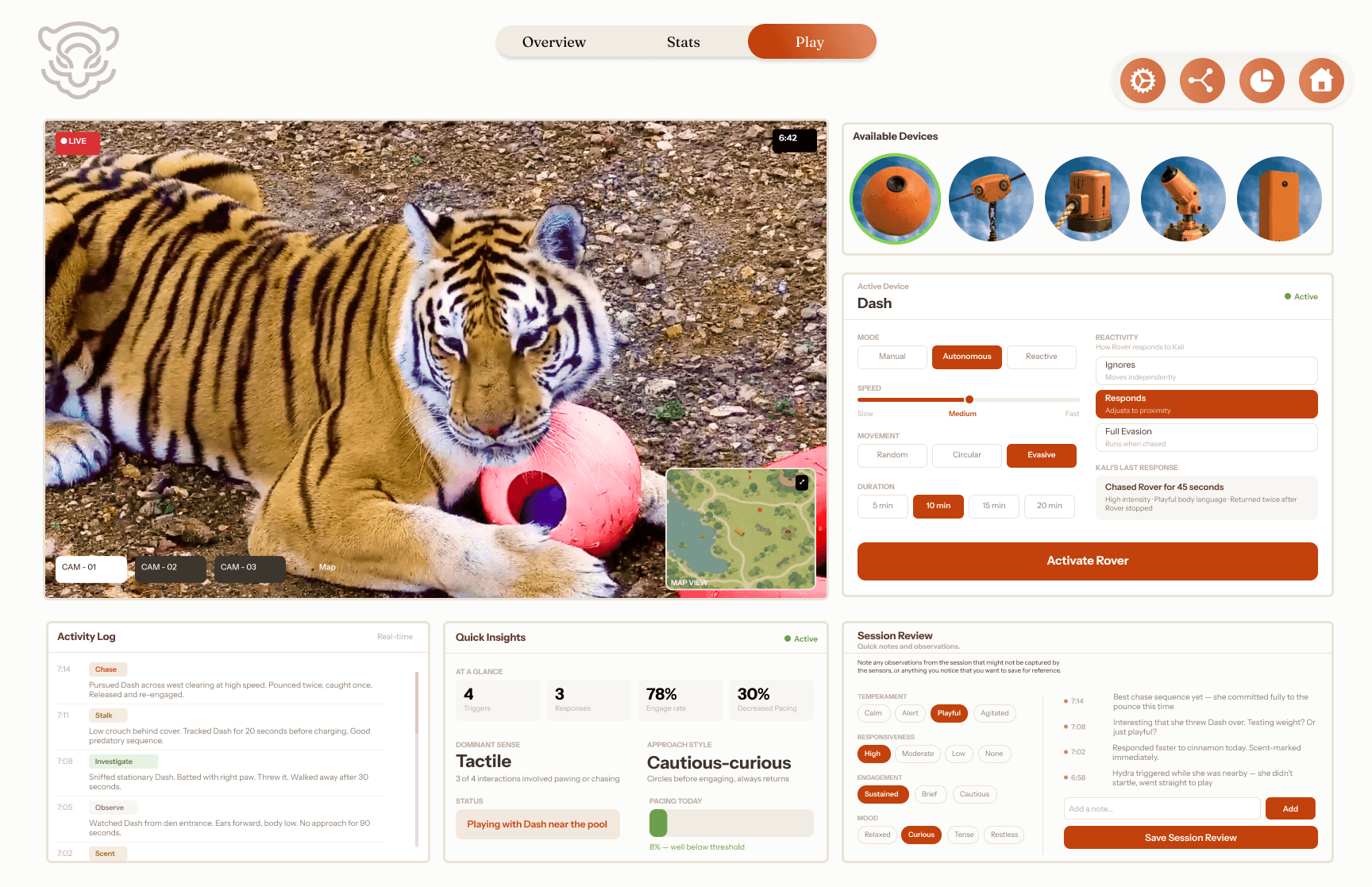
Dash is an autonomous ball that moves through the enclosure. It can be controlled manually by a caretaker, run autonomously on randomized paths, or react to the tiger's proximity. Speed, movement pattern, and reactivity are all adjustable.
It targets visual tracking, chasing, and pouncing behaviors.
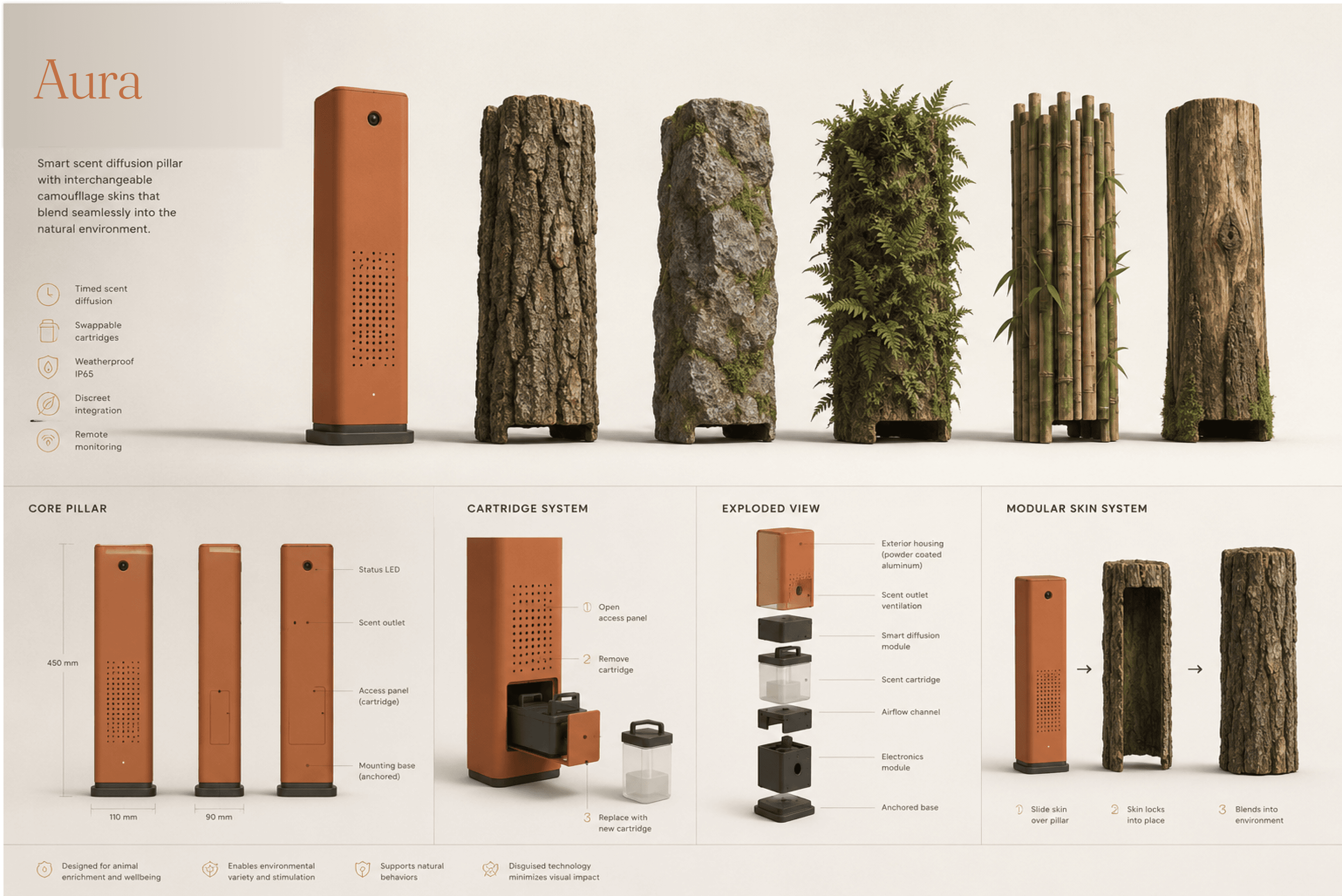
Aura
Aura is a scent diffuser pillar camouflaged into the environment. It releases interchangeable scent cartridges Scent is the most reliable engagement channel for tigers.
Activates natural investigation behaviors like sniffing, flehmen response, and scent marking.
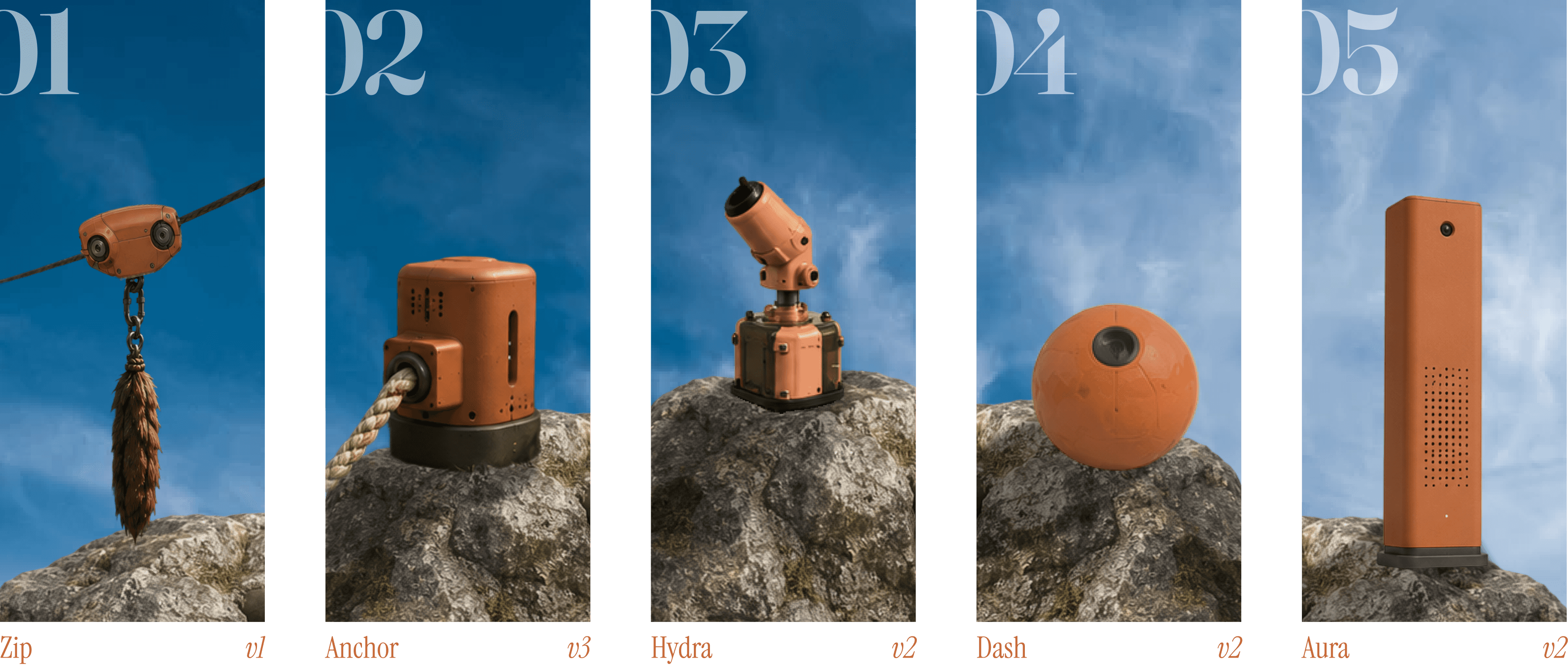
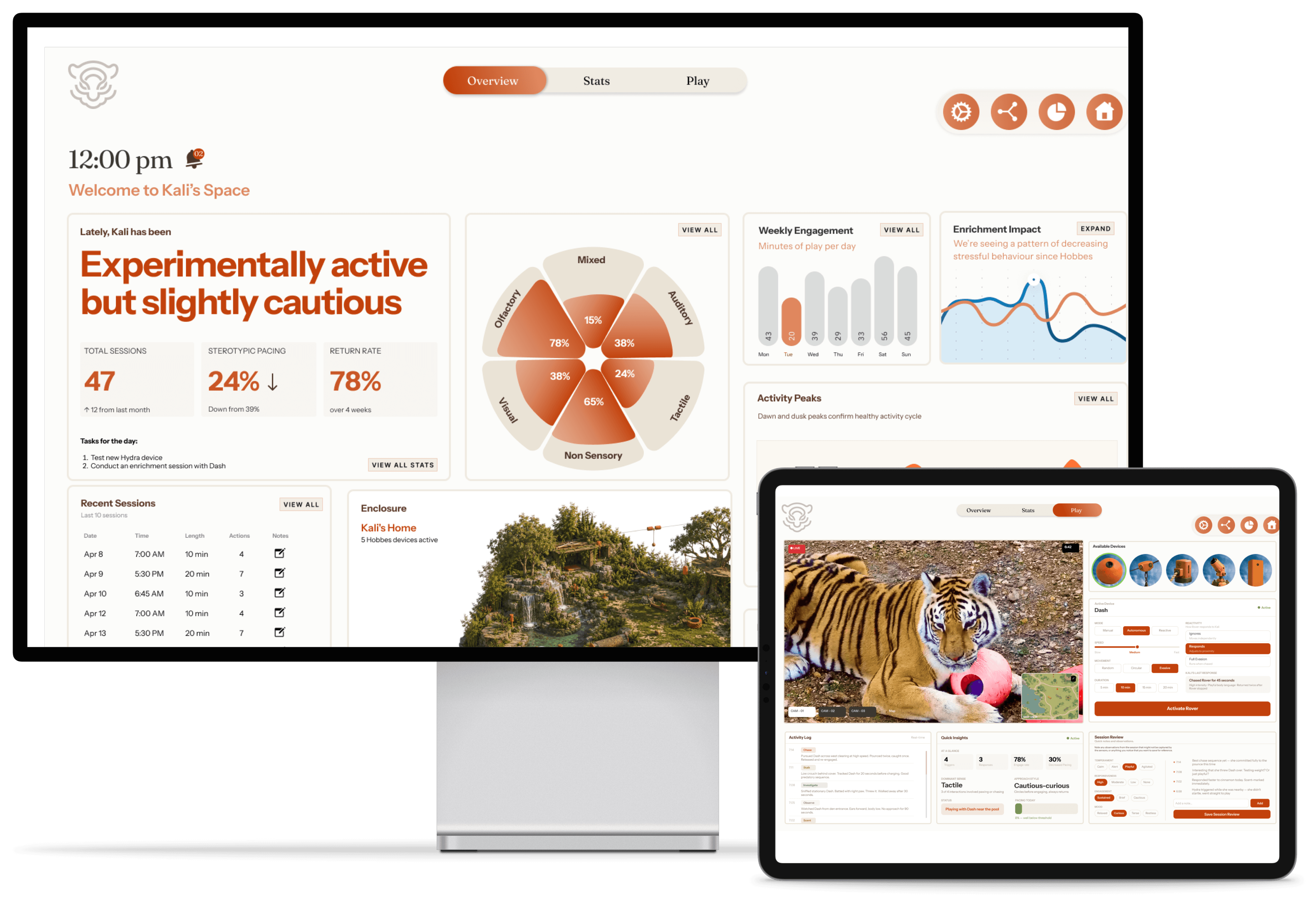
Play is the active control section. It includes a live video feed from the enclosure cameras with the option to toggle to the bird's eye enclosure map showing device locations and the tiger's position. The caretaker selects a device from the product images at the bottom, and the settings panel loads. Each device has the same layout: mode selection, device-specific options, intensity or speed controls, pattern selection, and duration. One button activates the device. Below the video, an activity log shows real-time observations as they happen. A session notes section lets the caretaker tag the session with quick observations like temperament, responsiveness, and mood, and add written notes. An emergency button is always visible in the corner.
Overview is the first thing a caretaker sees when they open the app. It gives a snapshot of the tiger's current state. How active has she been? What is her sensory profile looking like? What devices has she engaged with most? Are there any behavioural flags like increased pacing or decreased engagement? It also shows the five devices and their status, tasks for the caretaker, and the enclosure environment.
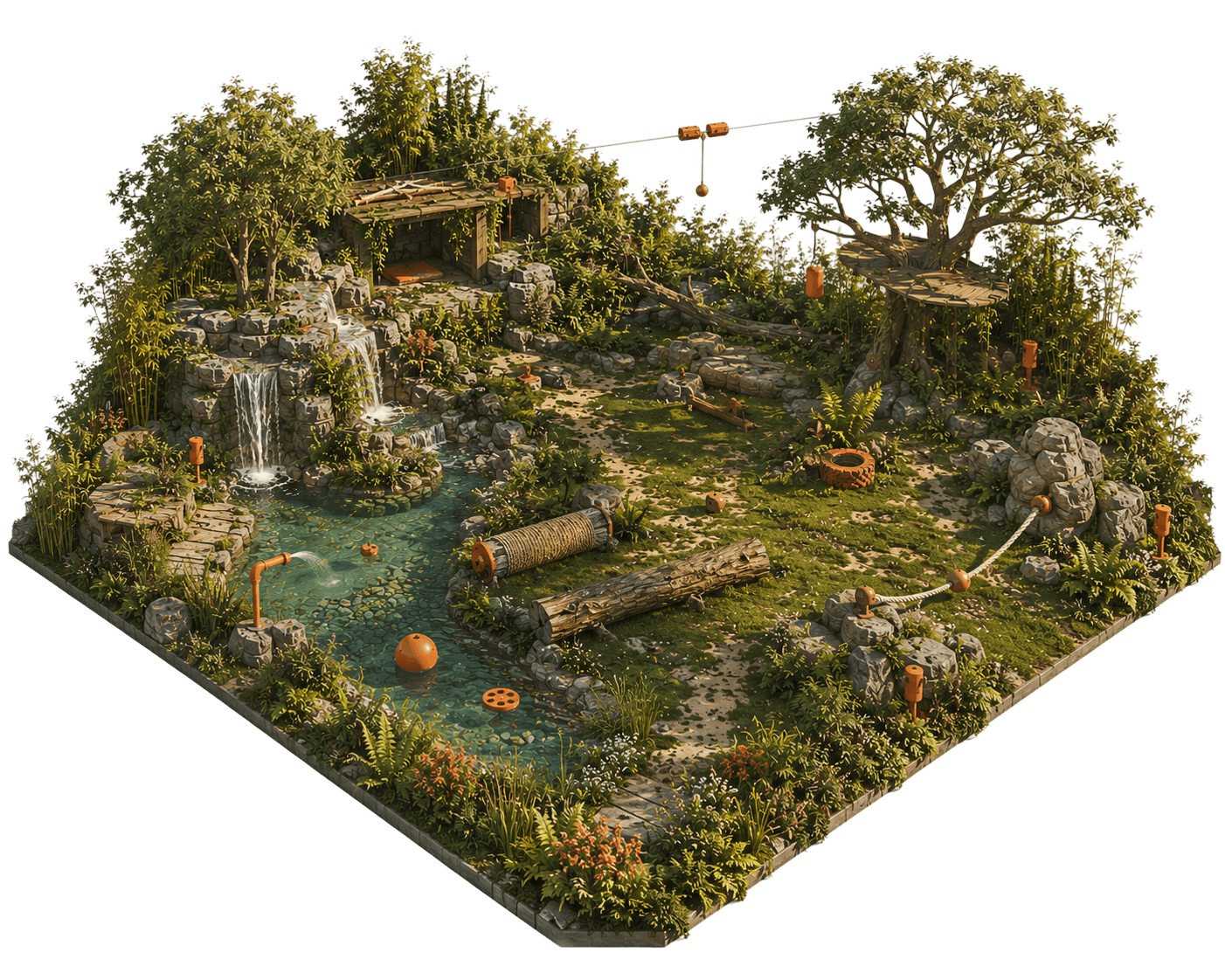
I designed an enclosure layout that shows how the five devices integrate into a naturalistic space. The environment includes a pool and waterfall area where Hydra is embedded, dense vegetation and clearings with Aura pillars scattered throughout, open terrain for Rover to move across, a zip line running between elevated points for Arc, and a rock wall section where Coil is mounted. Paths wind through the space. Cover and open areas alternate to create ambush opportunities.
The environment is not just a backdrop. It is part of the design. The placement of devices, the sightlines, the cover, and the terrain all reference what we know from research: stalking cover matters more than space alone, unpredictability reduces stereotypies, and tigers need a mix of sensory inputs across different zones.
Why this is different
The Hobbes Method in Practice
In research, the Hobbes Method was an observation framework. In the final design, it became the brain of the system.
Cameras and sensors capture every interaction. When a tiger engages with a device, the system scores it. Which senses were activated. How she approached. How long she stayed. Whether she came back.
Every session builds on an individual profile. Over weeks and months, patterns surface. This tiger is olfactory-dominant. Her engagement with Rover is increasing. Pacing drops on days with more varied enrichment.
The caretaker doesn't guess. The data is there.
broader ACI connections
Does this matters beyond tigers
Hobbes treats a tiger as a user. The tiger doesn't know it's interacting with technology. It's interacting with its environment. But that environment is instrumented. The devices respond. The sensors capture. The dashboard surfaces. The caretaker adapts. That loop between an animal and a computer system, mediated by a human, is animal-computer interaction in practice.
The architecture isn't locked to tigers. The devices, the scoring framework, the remote model could work for most animals. The Hobbes Method could be recalibrated for any species whose senses are understood.
what's next
Looking ahead
This is a design proposal. I haven't built these devices. I haven't watched a real tiger use them. The data in the dashboard is simulated.
There are open questions. Can these devices survive a 200kg animal? Can real-time tracking work at low latency? Where's the line between meaningful interaction and gamification? How do you convince a zoo on a tight budget to adopt a connected system when a boomer ball costs five dollars?
The value of this project is in the framework and the thinking, not in a shipped product.
I started wanting to learn about tigers. I ended up trying to understand them as individuals.
The research showed me the problem isn't just space or boredom. It's that captivity strips away agency, unpredictability, and anything to figure out. Hobbes is my attempt to put some of that back.
Five devices that target different senses. An environment designed around what we know. A dashboard that gives caretakers real tools. And at the centre, a method that turns enrichment from something we give to something we learn from.
It's not perfect. It's not tested. But it starts from a different place than most enrichment design: not what looks good to a human, but what actually matters to a tiger.